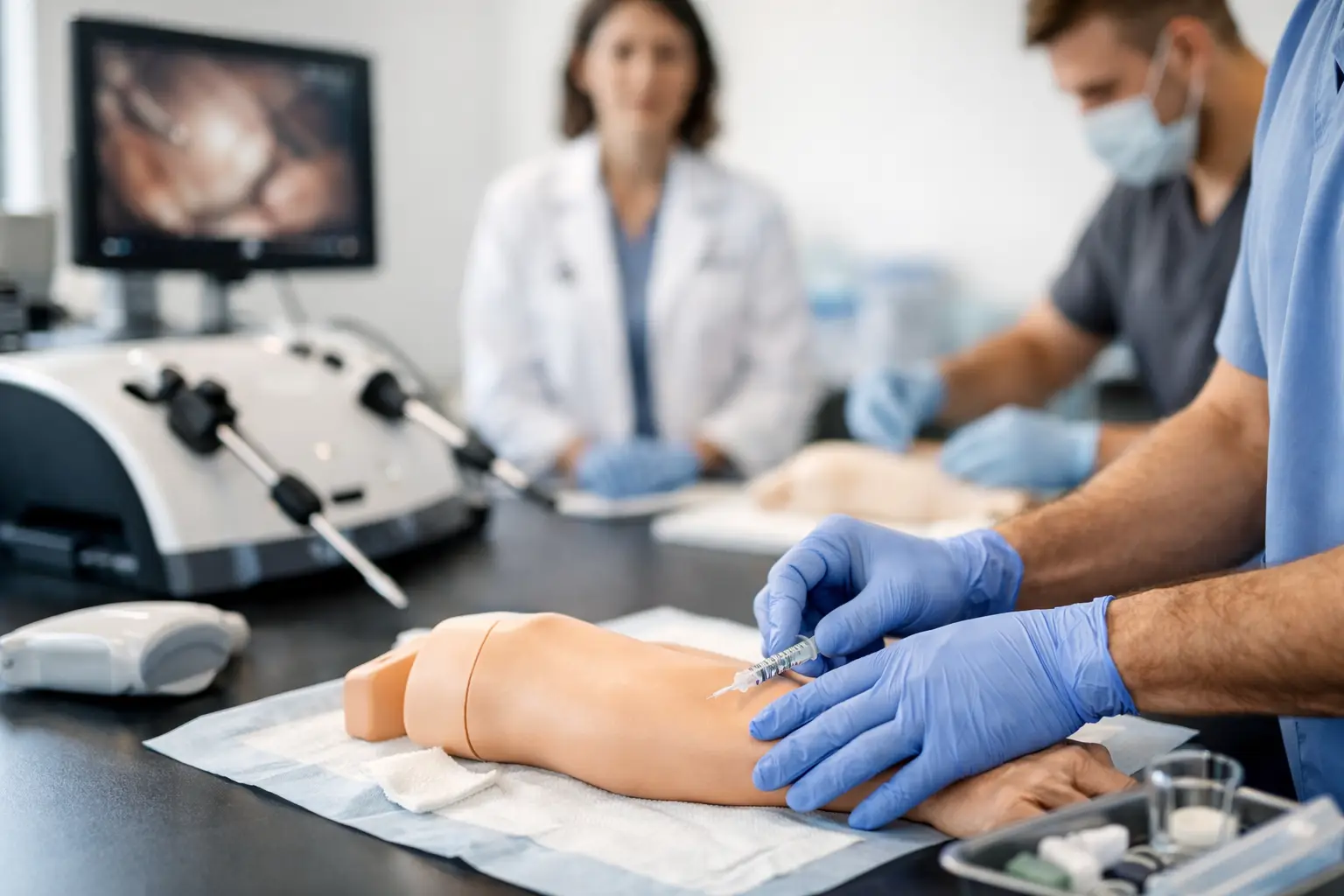
A clinician can understand every step of a procedure on paper and still hesitate when instruments are in hand, anatomy is variable, and time matters. That gap is precisely where procedural skills training has its greatest value. It does not simply teach movement or sequence. It develops the capacity to perform safely, consistently, and with sound clinical judgement under real professional conditions.
For healthcare professionals at any stage of practice, this matters because procedural competence is rarely a product of repetition alone. Good training must convert theoretical understanding into precise technical execution, while also strengthening decision-making, situational awareness, and communication within the wider clinical team. When those elements are taught separately, performance often becomes fragmented. When they are taught together, learning becomes far more durable.
What procedural skills training should actually develop
In serious clinical education, procedural skills training is not limited to learning how to complete a task. A procedure is never only mechanical. It requires anatomical understanding, equipment familiarity, timing, sterility, risk awareness, and the ability to respond when the expected sequence changes.
That is why effective programmes are built around more than a checklist. A learner may know the correct order of actions and still lack the tactile confidence, spatial orientation, or procedural flow needed for safe execution. Equally, a technically capable clinician may struggle if training has not addressed indication, contraindication, complication management, or communication with colleagues and patients.
High-quality training therefore develops three areas together. First, it builds technical accuracy – how a procedure is prepared, positioned, and performed. Second, it strengthens applied knowledge – why each step is taken, what anatomical or clinical principle supports it, and where common errors arise. Third, it improves professional judgement – when to proceed, when to pause, and when a different approach is more appropriate.
Why observation alone is not enough
Clinical environments remain essential learning settings, but observation has limits. Watching an experienced operator can be highly valuable for understanding rhythm, sequencing, and team dynamics. It is far less reliable as a sole method for building one’s own procedural competence.
Much of procedural expertise is invisible unless it is taught explicitly. Experienced clinicians often make small adjustments instinctively, based on tissue response, anatomical variation, instrument feedback, or patient-specific factors. Learners may not recognise these adjustments, let alone understand how to reproduce them. Without structured teaching, they may imitate superficial actions while missing the reasoning that makes those actions effective.
There is also the issue of opportunity. Clinical exposure is not always evenly distributed, and case mix does not necessarily align with learning needs. Some clinicians gain frequent exposure to routine procedures but limited access to more complex or anatomy-dependent work. Others see procedures performed but have little protected time to practise, ask questions, or receive detailed feedback.
This is where dedicated educational settings become particularly useful. In a well-designed course, the pace can be adjusted for learning rather than service pressure. Faculty can pause, explain, repeat, and correct. Learners can focus on quality of execution instead of simply keeping up.
The features of effective procedural skills training
Not all practical teaching produces the same outcome. The strongest procedural skills training is structured, clinically grounded, and explicit about learning objectives.
A useful programme begins with clear relevance. Participants should understand which procedure is being taught, in what clinical context it is used, and what level of competence the course is designed to support. This sounds obvious, yet it is a common weakness in skills education. Training that is too broad can become unfocused. Training that is too narrow may improve a specific technique without supporting wider procedural judgement.
Anatomy remains central. Procedures become safer and more precise when learners understand the underlying structures in three dimensions rather than as abstract diagrams. This is especially important in fields where small errors in angle, depth, orientation, or placement can alter outcomes significantly. Anatomy-based teaching supports not just accuracy, but confidence.
Repetition also matters, but not as mindless repetition. Practice should be deliberate. Learners need the chance to perform the same steps more than once while receiving expert feedback on efficiency, handling, positioning, and error correction. Repetition without feedback can reinforce poor habits. Repetition with precise supervision is where technical refinement begins.
Equipment familiarity is another underestimated factor. Procedural confidence improves when participants can test tools, compare systems, and understand how equipment choice influences technique. In practice, clinicians often work across institutions with different resources, so training should prepare them for variation rather than assume a single standard setup.
Feedback is where competence starts to mature
Many professionals attend technical courses hoping to gain confidence. Confidence is a useful outcome, but only when it is based on accurate self-assessment. Poorly designed training can leave participants feeling more confident without being measurably more competent. That is a risk in healthcare education.
The difference lies in feedback. Specific, expert feedback helps clinicians identify what is going well, what needs adjustment, and what should change immediately before habits settle. General encouragement has a place, but it is not enough. A participant needs to hear whether hand position is affecting precision, whether procedural flow is efficient, whether tissue handling is appropriate, and whether decision points are being recognised at the right time.
This kind of feedback is most useful when it is timely and anchored in observable performance. It should not be punitive, nor should it be vague. Strong faculty can maintain high standards while still making the learning environment focused and constructive.
Procedural skills training across career stages
One of the strengths of this area of education is that it remains relevant throughout a healthcare career, although the learning need changes over time.
For students and early-career clinicians, procedural training often centres on fundamentals. The objective is to build safe habits, orient learners to anatomy and instrumentation, and reduce uncertainty around core techniques. At this stage, structured supervision is essential because early errors can become persistent.
For postgraduate learners and developing specialists, the focus often shifts towards consistency, complexity, and judgement. They may already perform certain procedures, but want to improve efficiency, manage variation more confidently, or refine technique under expert observation.
For senior clinicians, the value is different again. Advanced courses may support skill expansion, adoption of newer methods, comparison of procedural approaches, or recalibration against current standards. Experienced practitioners are not returning to basic training. They are usually looking for precision, relevance, and peer-level educational exchange.
That is one reason premium medical education providers place so much emphasis on faculty quality and course design. Mature learners do not need generic instruction. They need clinically serious education that respects prior experience while still challenging performance.
Why context matters as much as technique
A procedure performed well in isolation is not always a procedure performed well in practice. Real clinical work includes time pressures, coordination demands, equipment constraints, and multidisciplinary communication. Procedural teaching should recognise that reality.
Courses are strongest when they integrate technical instruction with broader clinical context. That may include planning, patient selection, complication awareness, workflow, and collaboration across professional roles. A technically elegant performance has limited value if the indication is weak or the team communication fails.
This is particularly relevant in modern postgraduate education, where participants often want training that mirrors the complexity of real care pathways rather than isolated technical drills. Programmes that combine theory, anatomy, practical execution, and case-based discussion tend to produce more transferable learning.
LNP Academy’s Learn & Practice philosophy reflects this well – not by treating theory and practice as separate educational events, but by connecting them within the same structured learning experience.
Choosing the right training programme
For clinicians selecting a course, the most useful question is not simply whether a programme is hands-on. It is whether the training is aligned with actual professional need.
A good programme should make its level clear. Is it intended for foundation learning, skills consolidation, or advanced practice? It should also explain how learning is delivered – for example through anatomy-focused teaching, supervised practical sessions, case discussion, or equipment-based comparison.
Faculty credibility is equally important. Participants need instructors who not only understand the procedure, but can teach it well, explain variation, and respond to detailed clinical questions. There is a real difference between expert practice and expert teaching.
It is also worth considering the educational environment. Courses delivered in well-organised professional settings tend to support better concentration and smoother learning. When logistics, materials, and course flow are handled properly, participants can focus fully on skill development rather than administration.
Procedural competence is built gradually. No single course can replace experience, and no amount of experience automatically guarantees refinement. The most effective procedural skills training sits between those two truths. It accelerates learning, corrects avoidable errors, and gives clinicians a stronger framework for safe, precise practice.
The real value is not that it makes a procedure look easier. It is that it makes professional performance more deliberate, more reliable, and more clinically grounded when it matters most.


Leave a Reply