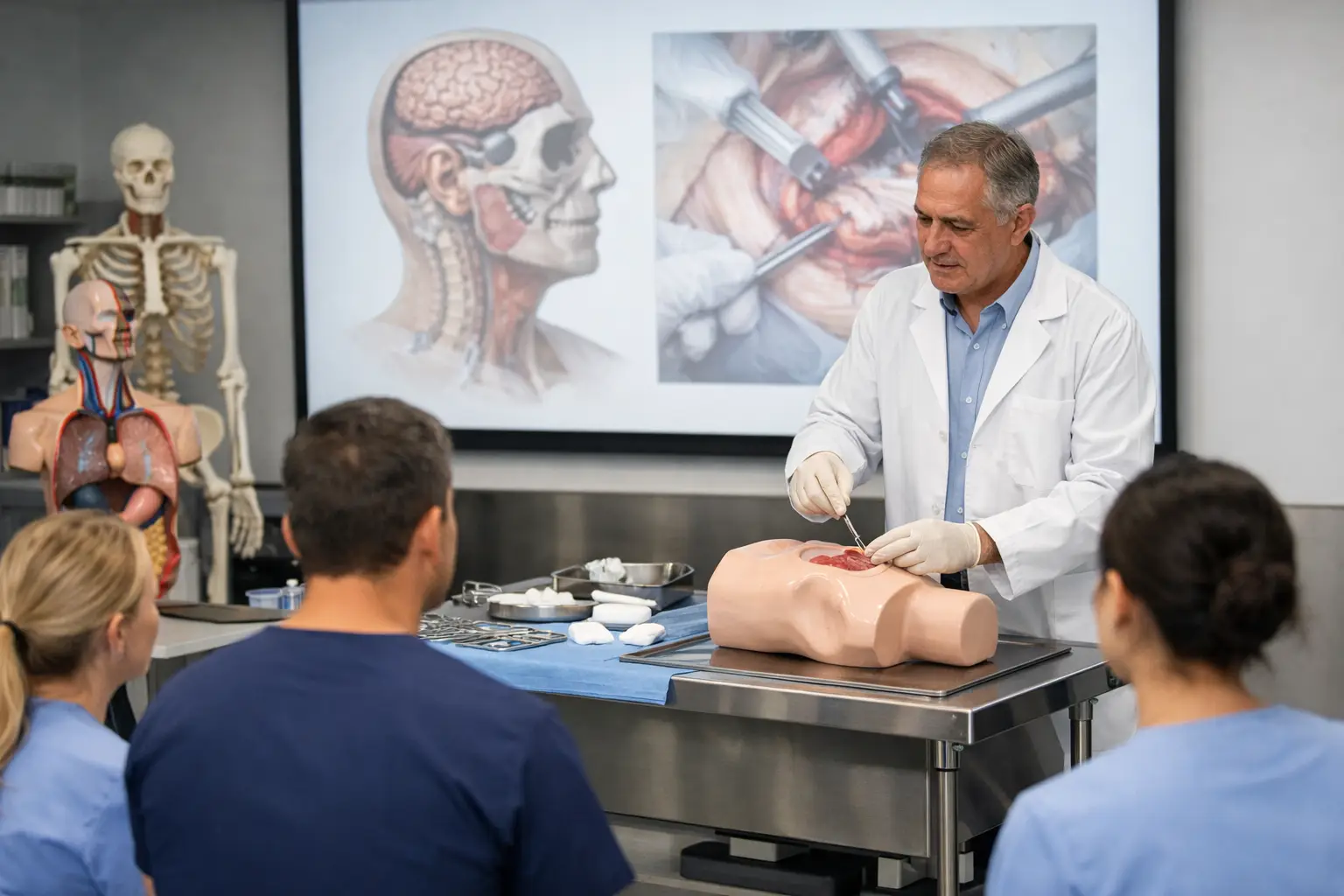
A difficult dissection rarely becomes difficult by surprise. More often, the challenge was present all along in the tissue planes, the vascular variation, the limited access, or the clinician’s incomplete mental map of what lay beneath the surface. That is why a surgical anatomy course for clinicians remains one of the most valuable forms of postgraduate training. It does not simply revisit anatomy as an academic subject. It reconnects anatomy to action, judgement and technical execution.
For practising clinicians, anatomy teaching must do more than refresh names and landmarks. It must support decisions made in theatre, in procedural suites, and at the bedside. The real question is not whether anatomy matters. It is how anatomy should be taught so that it improves confidence, precision and patient care.
Why a surgical anatomy course for clinicians matters in practice
Undergraduate anatomy often provides a necessary foundation, but clinical work quickly exposes its limits. Structures are no longer encountered in idealised diagrams or neatly separated layers. They are approached through specific operative windows, under time pressure, with pathology distorting normal planes and with variation that can materially alter risk.
A well-designed surgical anatomy course for clinicians addresses this gap directly. It interprets anatomical knowledge through a procedural lens. That means focusing on access routes, relationships relevant to dissection, danger zones, common variants, and the anatomical reasoning behind each technical step. For a surgeon, this may mean refining an approach to a region repeatedly encountered in practice. For an interventionalist or other procedural clinician, it may mean understanding depth, orientation and adjacent structures with greater accuracy.
This matters at every stage of professional development. Early-career clinicians often need anatomy to become clinically usable rather than theoretically familiar. More experienced specialists may need targeted regional revision before adopting a new technique, broadening scope of practice, or returning to a less frequently performed procedure. Senior professionals may seek advanced courses because anatomical precision remains central to good judgement, however long one has been in practice.
What clinicians should expect from a high-quality course
Not all anatomy teaching serves the same purpose. A course aimed at school leavers or pre-clinical students will not meet the needs of a clinician responsible for procedural outcomes. The standard should therefore be higher, and the design more deliberate.
First, the teaching must be clinically grounded. Anatomy should be presented in relation to exposure, instrumentation, imaging, complications and operative strategy. If the content remains too abstract, retention may be reasonable but transfer to practice will be weak.
Second, the course should be regionally and procedurally relevant. Broad surveys have value, but many clinicians benefit most from focused learning. A head and neck specialist, a gynaecological surgeon and a musculoskeletal clinician require different anatomical emphasis, even when principles of safe dissection are shared. The closer the alignment between course content and real procedural work, the greater the educational return.
Third, the faculty should be able to teach both anatomy and application. This usually means collaboration between anatomists and experienced clinicians, or clinician-educators with strong anatomical expertise. Pure anatomical detail without procedural interpretation can feel detached. Pure technical instruction without careful anatomical explanation can become superficial.
Finally, the learning environment matters. High-level postgraduate education is not only about information delivery. It depends on structure, pacing, direct observation, opportunities for questions, and a professional setting where clinicians can focus on improving performance.
The value of cadaveric and anatomy-based procedural training
For many specialties, cadaveric training remains one of the strongest educational formats available. It allows clinicians to study depth, planes, tactile relationships and spatial orientation in a way that imaging alone cannot fully replicate. This is especially important when procedures involve narrow corridors, delicate neurovascular structures or layered dissections where small errors carry large consequences.
That said, cadaveric teaching is not automatically superior in every context. Its value depends on preparation and instructional quality. Without clear learning objectives, faculty guidance and procedural framing, even excellent specimens can become an inefficient teaching resource. The most effective courses combine specimen-based learning with structured demonstration and discussion of indications, technique and risk.
Anatomy-based procedural training can also include models, 3D planning tools and simulation-based practice. These are not replacements for all forms of dissection, but they can be highly effective when used properly. Three-dimensional models may clarify difficult spatial relationships before hands-on work begins. Procedural simulation may allow repetition of key steps that cadaveric sessions cannot always provide in volume. The strongest programmes usually blend methods rather than relying on one format alone.
How anatomy teaching improves procedural judgement
Clinicians often think of anatomy education as a route to better technical performance, and that is correct. But its influence is broader. Good anatomical training strengthens judgement before the first incision or intervention is made.
It improves procedural planning by helping clinicians anticipate the likely course of structures, identify where variation may alter technique and assess whether a chosen approach remains appropriate in the presence of disease or previous treatment. It also sharpens intraoperative decision-making. When expected planes are absent or distorted, the clinician with a stronger anatomical framework is better equipped to pause, reorient and adapt safely.
This is one reason anatomy teaching should not be viewed as remedial. High-performing clinicians often return to anatomy because advanced practice depends on a more detailed and more usable understanding of structure. As procedures become more specialised, minimally invasive, image-guided or reconstructive, anatomical sophistication becomes more rather than less important.
Choosing the right surgical anatomy course for clinicians
Course selection should begin with the clinician’s actual need. The broadest course is not always the best course. A targeted programme may be more useful if the goal is to prepare for a new operative technique, consolidate confidence in a high-risk region, or translate anatomical knowledge into a specific procedural setting.
It is worth considering whether the course is pitched at the right level. Mixed-level teaching can be productive, but only if carefully managed. A consultant seeking advanced regional anatomy may find little benefit in a course designed mainly for foundation-level revision. Equally, a junior doctor may struggle in an overly specialist environment without sufficient scaffolding.
The ratio between theory and hands-on practice also deserves attention. Some clinicians need conceptual clarification first. Others benefit most from direct practical exposure with expert supervision. Neither approach is inherently better. It depends on prior experience, the complexity of the anatomy and the intended application.
International programmes can add further value when they bring together different clinical perspectives, faculty expertise and educational methods. In a city such as Budapest, where high-level medical education can be delivered within a well-organised international framework, participants may gain not only technical insight but also broader professional exchange. For busy clinicians, however, logistics still matter. A premium course should be educationally strong and operationally well run.
Anatomy learning as part of continuing professional development
Continuing professional development is often discussed in terms of compliance, accreditation or career progression. Those elements are real, but they are not the main reason anatomy courses remain relevant. Their deeper value lies in helping clinicians maintain a high standard of applied understanding as practice evolves.
Procedures change. Devices change. Imaging changes. Expectations around safety, documentation and outcomes continue to rise. Anatomy remains constant in one sense, but the way clinicians must use anatomical knowledge changes with each new technique and each increasing level of specialisation.
A serious educational provider recognises that clinicians do not attend courses for theory alone. They attend because they want practical understanding that can be carried back into theatre, clinic or training programme. When anatomy teaching is structured around that principle, it supports not only skill development but professional assurance. LNP Academy’s educational philosophy reflects this emphasis on learning that is directly transferable to clinical work.
The best time to revisit anatomy is not when confidence has already been shaken. It is before a new procedure, before a step up in responsibility, or simply when experience has revealed that textbook familiarity is not the same as applied mastery. For clinicians who want their anatomical knowledge to function under real procedural demands, the right course offers something more useful than revision. It offers clarity where precision matters most.


4 responses to “Surgical Anatomy Course for Clinicians”
[…] that serves surgery rather than treating anatomy as a separate academic subject. Participants need anatomical teaching that informs access, dissection planes, fixation strategy, avoidance of injury, and interpretation […]
[…] access difficulty, tissue quality, or proximity to critical structures. This is one reason anatomy-based training remains so valuable throughout a surgical […]
[…] means anatomy must be taught as a live clinical framework, not as an isolated academic subject. Procedural teaching should […]
[…] addresses this by building from foundations to application. The strongest programmes begin with anatomy and biomechanics, move into diagnostic reasoning and treatment planning, and then progress to supervised technical […]