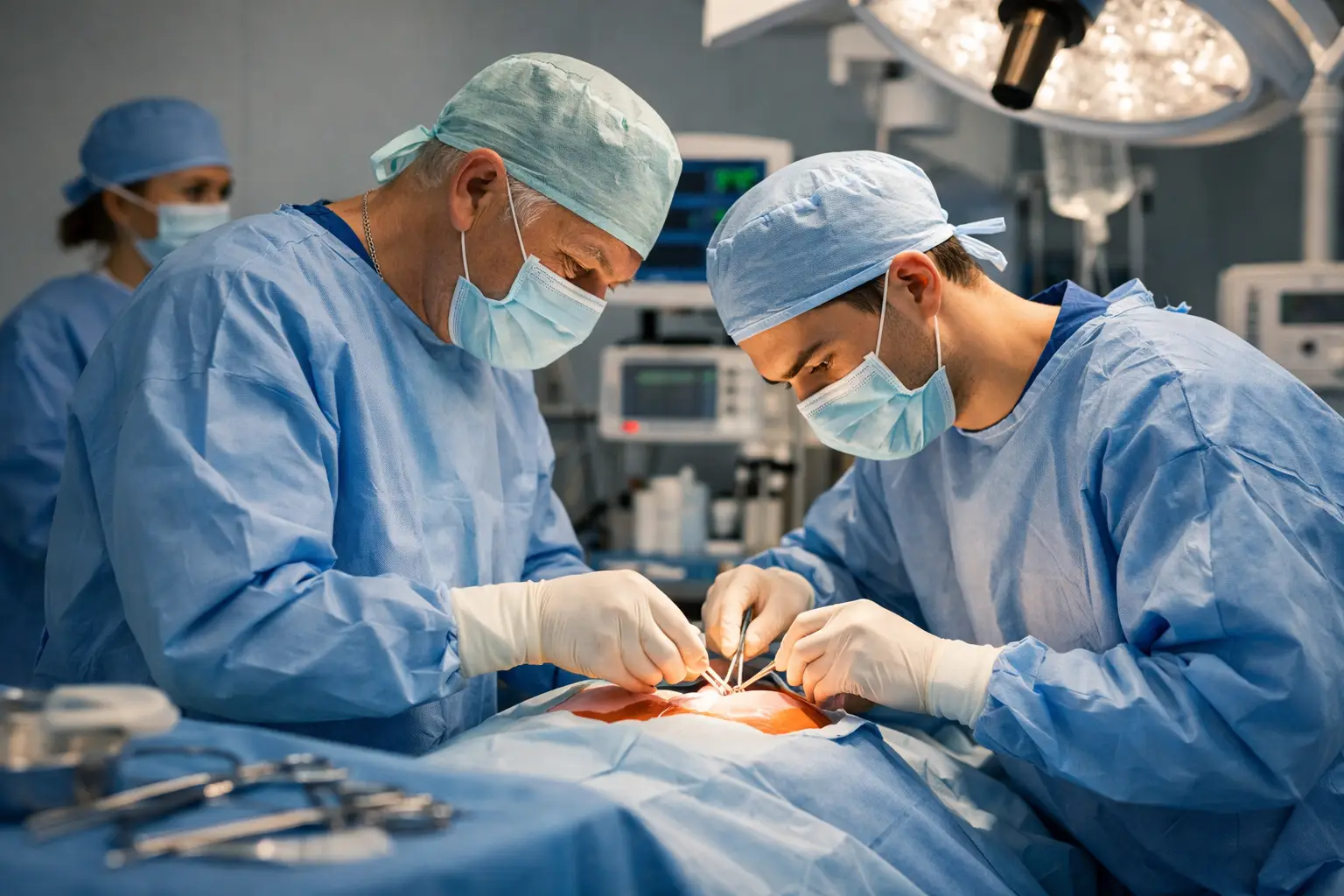
A surgeon can understand every step of a procedure intellectually and still feel the gap when instrument, tissue and anatomy meet in real time. That gap is exactly where hands on surgical training remains indispensable. For clinicians working in technically demanding fields, practical repetition does more than improve dexterity – it sharpens judgement, reinforces anatomical orientation and exposes the small decisions that define safe operative performance.
The case for practical training is not nostalgic, nor is it a rejection of digital education. Contemporary surgical learning rightly includes online teaching, video libraries, virtual planning and case-based discussion. Yet surgery is not learned fully on a screen. It is learned when knowledge is tested against resistance, depth perception, tissue handling, spatial limitation and procedural sequence under conditions that resemble clinical reality.
What hands on surgical training develops beyond theory
The most obvious benefit of hands on surgical training is technical skill, but that description is too narrow. Good practical education develops a chain of competencies that are tightly connected. Instrument handling improves, certainly, but so does the ability to translate two-dimensional imaging into three-dimensional anatomy, anticipate the next operative step and recognise when normal anatomy is absent or distorted.
This matters because procedural safety rarely depends on memorising a list of steps. It depends on knowing what to do when visibility is reduced, exposure is imperfect or tissue planes are less distinct than expected. These are not abstract problems. They are the routine realities of surgery. Training that allows clinicians to work through them in a structured environment is far more valuable than passive observation alone.
Hands-on learning also changes the pace of comprehension. In lecture-based settings, a technique can appear straightforward because the uncertainty has been edited out. In practical sessions, uncertainty becomes visible. Participants begin to see where hand position affects access, where anatomy changes the angle of approach and where a seemingly minor adjustment improves precision. That shift from understanding a procedure to executing it is where genuine progression occurs.
Why simulation alone is not always enough
Simulation has an important role in modern education, and in some contexts it is highly effective. It supports early familiarisation, procedural mapping and rehearsal without patient risk. It can also be repeated efficiently, which is a major advantage in busy professional training pathways.
Even so, simulation has limits. Not every platform reproduces tactile feedback convincingly, and not every scenario captures the variability of live anatomy. A clinician may perform well in a digital environment yet still struggle with real instrument control, force application or orientation in confined operative spaces. The issue is not that simulation lacks value. The issue is that it addresses only part of surgical competence.
For that reason, the strongest programmes do not place simulation and practical anatomy-based learning in opposition. They sequence them intelligently. Foundational concepts may begin online or with guided planning. They are then tested through practical exercises, model-based rehearsal, cadaveric dissection or supervised procedural workshops. This layered approach respects both efficiency and realism.
The role of anatomy in procedural confidence
In advanced specialties such as ENT, maxillofacial surgery and other anatomy-intensive fields, confidence is inseparable from anatomical clarity. A practitioner may know the landmarks in principle, but confidence deepens when those landmarks are repeatedly identified, approached and related to procedural movement.
This is why anatomy-based hands on surgical training is particularly valuable for postgraduate learners and experienced clinicians alike. For the trainee, it builds orientation. For the established specialist, it supports refinement, adaptation and the safe adoption of newer techniques. In both cases, anatomy turns procedural learning from instruction into understanding.
The difference between watching and doing
Observation remains useful, especially when guided by expert commentary. Live demonstrations can reveal decision-making, economy of movement and operative workflow in a way textbooks cannot. However, watching an expert is not the same as performing the task.
The difference is cognitive as well as physical. When clinicians perform a procedure themselves, they must control sequence, interpret anatomy actively and recover from minor errors in real time. Those demands expose weak points quickly. That can feel uncomfortable, but it is precisely what makes practical education effective.
A strong training environment makes that discomfort productive rather than discouraging. Faculty feedback should be specific, timely and technically precise. Participants should understand not only that something is incorrect, but why it is incorrect and how to adjust. Programmes with low faculty engagement often miss this point. Equipment may be excellent, but without expert supervision the educational value can remain superficial.
What to look for in hands on surgical training
Not all practical courses offer the same educational return. For clinicians investing time and professional development budget, the structure of a programme matters as much as the topic itself.
First, the training should be clinically grounded. That means the practical element is linked clearly to indications, patient selection, anatomy, workflow and complication awareness. A session that focuses only on mechanical repetition without clinical framing may improve familiarity, but not necessarily judgement.
Second, the faculty should be credible and actively involved. Experienced instructors do more than demonstrate technique. They explain variation, discuss limitations and share the reasoning behind operative choices. That is especially important for experienced participants, who often attend not for basic instruction but for refinement and perspective.
Third, the environment should support realistic practice. This may involve anatomical specimens, procedural models, 3D planning tools or equipment testing in settings that reflect actual professional use. The aim is not to imitate theatre conditions perfectly in every detail. The aim is to reproduce the decisions, constraints and movements that shape real procedures.
Fourth, the group size matters. Smaller groups generally allow more repetition, closer supervision and better technical correction. Large audiences may work well for lectures, but practical education depends on access.
Why experienced surgeons still benefit
There is a persistent misconception that hands on surgical training is mainly for juniors. In reality, senior clinicians often derive significant value from high-level practical courses. New devices, revised approaches and increasingly specialised procedures require opportunities for structured rehearsal. Even very experienced surgeons benefit from environments where they can test a technique before integrating it into practice.
There is also value in revisiting established procedures. Repetition at an advanced level is not remedial. It is part of maintaining precision. Over time, technique can drift subtly. Practical education offers a chance to recalibrate against current standards, compare methods with peers and revisit anatomical principles with fresh attention.
This is where well-designed international programmes can be especially useful. They bring together different operative traditions, faculty perspectives and technical preferences in a way that broadens professional judgement without reducing everything to a single method. In a field as complex as surgery, that comparative exposure is often more educational than certainty.
Practical training and patient safety
The strongest argument for hands on surgical training is not convenience or professional prestige. It is patient safety. Every opportunity to refine movement, improve orientation and rehearse decision-making outside the clinical encounter matters.
That does not mean practical training removes risk entirely or guarantees competence after a single course. It means that structured rehearsal reduces avoidable uncertainty. It allows clinicians to make errors in an educational setting, receive correction and return to practice better prepared. For procedures with steep learning curves or delicate anatomical relationships, that preparation is not optional in any serious sense.
Centres that build education around a clear Learn & Practice philosophy understand this well. Practical teaching should not be treated as an add-on to theory, nor as a marketing phrase. It is the point at which knowledge becomes clinically usable.
A better standard for surgical education
The future of surgical education is unlikely to be purely digital or purely traditional. It will be blended, selective and increasingly focused on relevance. Online learning will continue to support knowledge acquisition efficiently. Planning technologies will become more sophisticated. But the clinician still has to hold the instrument, read the anatomy and make the decision.
That is why practical education remains central. The most effective hands on surgical training does not simply teach how to complete a procedure. It teaches how to think, adapt and operate with greater control when the procedure becomes less predictable than the textbook promised.
For any clinician serious about technical development, that is the standard worth seeking – not training that looks impressive on paper, but training that changes how you perform when precision matters most.


4 responses to “Why Hands On Surgical Training Still Matters”
[…] professionals already working in demanding clinical settings, the question is not whether hands-on training matters. The more useful question is what separates a meaningful workshop from one that merely […]
[…] many specialties, cadaveric training remains one of the strongest educational formats available. It allows clinicians to study depth, […]
[…] this reason, the best course formats usually combine several educational layers. Pre-course theoretical preparation may establish common […]
[…] hand positioning, instrument selection, operative flow or team coordination. That gap between knowing and doing is precisely where well-run workshops are most […]