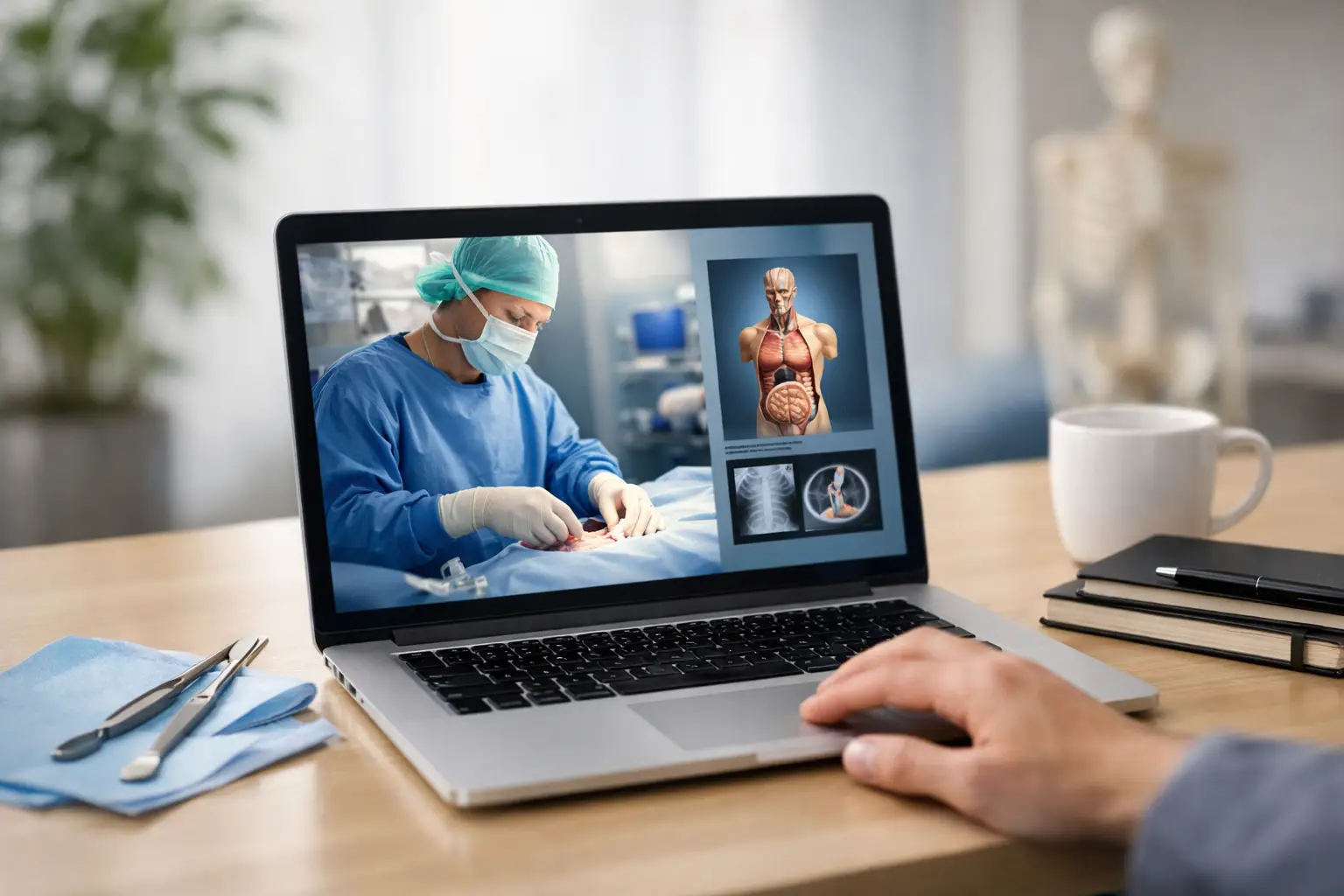
A consultant preparing for a new technique, a registrar refining anatomical judgement, and a medical student seeking clearer procedural understanding do not need the same teaching. That is why online surgical education courses are only valuable when they are built with clinical purpose, not simply packaged for convenience. For healthcare professionals, the question is rarely whether online learning has a role. The more useful question is which courses genuinely improve knowledge, judgement and procedural confidence.
Why online surgical education courses matter
Surgical education has changed because clinical work has changed. Time in theatre is finite, case exposure is variable, and access to specialist faculty is often shaped by geography, rota pressures and institutional capacity. Online learning helps address these limitations, but only when it is designed as serious professional education rather than passive content delivery.
High-quality online surgical education courses can create structured access to expert teaching that might otherwise be difficult to obtain. They allow clinicians to revisit complex anatomy, review procedural steps before a case list, and build conceptual understanding at a pace that fits around practice. For postgraduate learners in particular, this flexibility can support consistent development across busy service commitments.
That said, flexibility is not the same as educational depth. A course that is easy to access but weak in academic quality may create a false sense of competence. In surgery, that trade-off matters. Good online education should strengthen clinical reasoning and technical understanding, not reduce learning to superficial familiarity.
What separates strong online surgical education courses from weak ones
The first marker is faculty quality. Surgical teaching must be led by clinicians and educators with direct procedural expertise, current practice experience, and the ability to explain not only what to do, but why it is done that way. Learners at every level benefit when teaching includes decision points, anatomical landmarks, common errors and variations in approach.
The second marker is structure. Strong courses are built around clear educational objectives. They move logically from anatomy and indications to planning, execution, complication awareness and post-procedural considerations. This matters because surgical learning is cumulative. If teaching jumps too quickly into operative detail without establishing context, participants may remember fragments but fail to build usable understanding.
The third marker is clinical relevance. Generic content has limited value for professionals who need material that reflects real practice. The best programmes use case-based teaching, procedural breakdowns, imaging correlation, and clinically grounded discussion rather than abstract theory alone. In some areas, 3D planning or model-based demonstration can deepen understanding further, particularly where spatial reasoning is central to safe execution.
Assessment also deserves attention. Not every online course needs formal examination, but there should be some way to test understanding. This may include scenario-based questions, reflective tasks, faculty-led discussion or structured checkpoints within the programme. Without some form of consolidation, learners may complete a course without identifying gaps in their own knowledge.
The limits of online learning in surgery
Online education is highly effective for theoretical consolidation, anatomy-focused revision, procedural sequencing and exposure to expert perspectives. It is less effective when treated as a replacement for supervised practical training. Surgery remains a discipline in which manual skill, operative judgement and team-based execution are developed through guided practice in real clinical environments.
This is where some course selection goes wrong. A polished online platform can suggest comprehensiveness, but not every learning need can or should be met digitally. If your goal is to understand the rationale, steps and decision-making behind a procedure, online learning may be ideal. If your goal is to demonstrate hands-on competence, online study should be one part of a broader educational pathway.
For this reason, many of the most credible programmes sit within blended models. Online components prepare the learner before attending workshops, anatomy-based training, supervised demonstrations or technical skills sessions. This sequencing often produces better educational outcomes because participants arrive with stronger baseline knowledge and can use in-person time more effectively.
How to choose the right course for your stage of training
The value of a course depends heavily on professional context. A university student or foundation-level learner often needs clarity in core anatomy, theatre principles and procedural observation. At this stage, the best online surgical education courses explain fundamentals carefully and avoid assuming specialist background knowledge.
For trainees and registrars, priorities are usually different. They may need procedural frameworks, complication awareness, operative planning and specialty-specific updates that connect directly to clinical responsibilities. These learners often benefit from teaching that balances exam-relevant knowledge with practical decision-making.
Experienced specialists and senior surgeons tend to look for narrower and more advanced educational value. They may be assessing new techniques, revisiting complex anatomical regions, comparing procedural approaches or seeking internationally informed perspectives from expert faculty. At this level, the course must offer depth, precision and contemporary relevance. Broad introductory material is unlikely to justify their time.
It is also worth considering whether the course is multidisciplinary where appropriate. Modern surgical care rarely depends on the surgeon alone. Anaesthetic teams, nursing staff, coordinators, technical specialists and allied professionals all influence workflow, safety and outcomes. In selected topics, multidisciplinary education can improve communication, planning and team performance in ways that purely single-discipline teaching cannot.
Questions worth asking before you enrol
A credible course should make its educational aims and teaching methods transparent. You should be able to identify who teaches it, what level it is designed for, how the material is delivered, and what practical relevance it offers. If those basics are unclear, caution is sensible.
Ask whether the programme is evidence-based and clinically current. Surgical practice evolves, and educational content should reflect contemporary standards rather than outdated routine. Ask whether anatomy is taught in a way that supports procedural understanding rather than existing as a detached academic subject. Ask whether the course includes real clinical cases, operative reasoning and complication management.
It is also useful to consider the format. Recorded teaching offers flexibility and repeat viewing, which is helpful for revision and busy clinicians. Live online teaching allows interaction, questioning and faculty engagement, which may be more valuable for nuanced topics. Neither is inherently better. It depends on your learning style, timetable and the complexity of the subject.
Finally, consider what happens after the course. The strongest educational providers do not treat completion as the endpoint. They position learning within a wider developmental framework, whether that means follow-on workshops, advanced modules, practical training opportunities or international collaboration. This matters because surgical expertise is built progressively.
Why practical orientation matters most
In medical education, there is often a gap between knowing and doing. In surgery, that gap can be especially pronounced. A learner may understand terminology, recall steps and recognise instruments, yet still feel uncertain when applying that knowledge to real clinical situations. Good online education narrows that gap by making theory operational.
This is why practical orientation should be a deciding factor. Teaching should show how anatomy informs access, how planning affects execution, where judgement changes intra-procedurally, and how technical choices relate to patient-specific considerations. Even in a digital format, education can remain grounded, detailed and directly applicable.
Providers with a serious educational philosophy tend to perform better here. LNP Academy, for example, has built its approach around structured learning that links theory with practice, supporting healthcare professionals through clinically relevant programmes delivered in both online and in-person formats. That model reflects an important truth about surgical education: knowledge is most valuable when it can be applied with confidence and precision.
The real measure of a good course
A good course does not simply leave you informed. It leaves you clearer, more accurate in your judgement, and better prepared for the next clinical step. Sometimes that means understanding a procedure more deeply before entering theatre. Sometimes it means recognising the limits of your current competence and identifying what further training is needed.
That distinction matters. The best online surgical education courses do not promise shortcuts. They offer structured, credible learning that respects the standards of modern clinical practice and the realities of professional development. For surgeons and healthcare professionals investing serious time in education, that is the standard worth expecting.
Choose courses that treat your learning with the same seriousness you bring to patient care. That is where online education becomes genuinely useful.


Leave a Reply