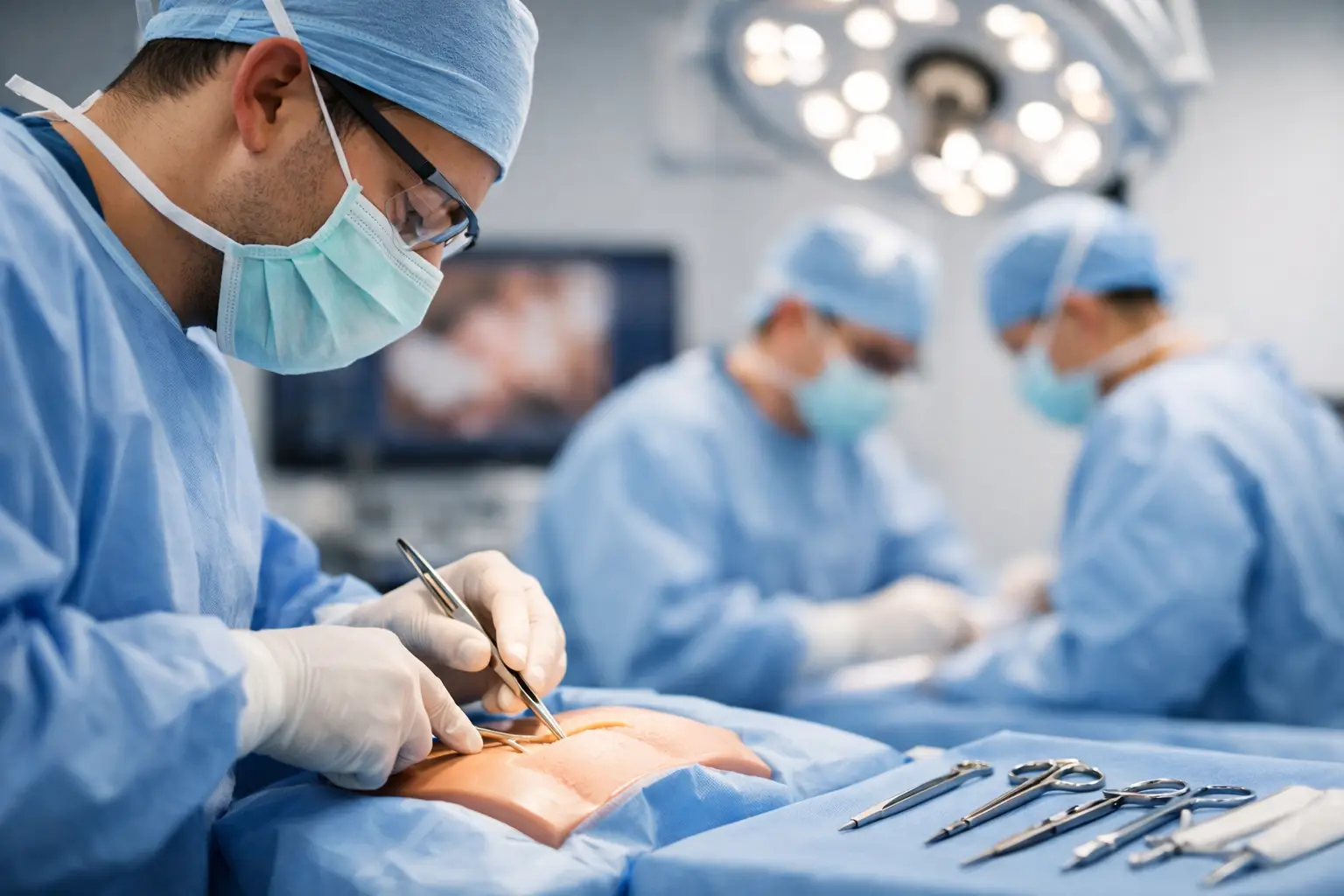
A surgeon rarely struggles because of a lack of effort. More often, progress stalls because practice is too broad, feedback is inconsistent, or technical training is separated from clinical judgement. When clinicians ask how to improve surgical skills, the most useful answer is not simply to do more cases. It is to train with greater structure, sharper observation, and clearer performance standards.
Technical ability in surgery is built gradually, then tested suddenly. A well-executed procedure depends on much more than hand movements. Exposure, tissue handling, instrument choice, spatial judgement, timing, communication, and decision-making all interact under pressure. That is why meaningful improvement requires a training model that reflects real operative demands rather than isolated repetition.
How to improve surgical skills with deliberate practice
The strongest gains usually come from deliberate practice rather than passive experience. Repetition matters, but only when it is focused on a specific element of performance. A trainee who closes fifty wounds in the same way may reinforce existing habits. A trainee who spends one session refining needle angle, another improving economy of motion, and another working on tension control is far more likely to improve.
This distinction is important at every stage of a surgical career. Early learners may need to establish reliable basic motor patterns and instrument familiarity. More experienced clinicians may be refining procedural flow, managing difficult anatomy, or reducing operative inefficiency. In both cases, improvement begins by breaking a complex task into trainable parts.
A useful question is not, “How did the case go?” but, “Which component of my performance most limited the outcome?” Sometimes the answer is dexterity. Sometimes it is positioning, planning, or anticipation. That level of honesty allows training to become precise.
Define the skill before trying to improve it
“Surgical skill” is often discussed as though it were a single attribute. In practice, it includes several domains. Manual dexterity is one. So is three-dimensional anatomical understanding. So are visual attention, procedural sequencing, and the ability to adapt when tissue planes are unclear or conditions change unexpectedly.
Improvement tends to accelerate when these domains are separated. A clinician struggling in minimally invasive work may not primarily have a hand skill problem. The issue may be camera navigation, depth perception, awkward port geometry, or inefficient bimanual coordination. Similarly, difficulty in open procedures may reflect exposure strategy and tissue respect rather than a lack of confidence with instruments.
Once the limiting factor is identified, training becomes more efficient. Vague goals such as “be better in theatre” are rarely helpful. Specific goals such as “reduce unnecessary hand movements during knot tying” or “improve dissection accuracy around critical structures” are easier to teach, practise, and assess.
Anatomy and procedural understanding come first
No amount of technical repetition can compensate for weak anatomical orientation. Safe surgery depends on recognising tissue planes, understanding variation, and predicting where risk lies before dissection begins. For that reason, clinicians who want to improve should revisit anatomy not as a classroom subject, but as an operative map.
This is particularly relevant when moving into more advanced procedures. A surgeon may know the textbook anatomy well, yet still struggle to translate that knowledge into intraoperative judgement. The question is not only where a structure should be, but how it presents from a given approach, in a specific position, and under variable pathology.
Procedural understanding is equally important. If each step of an operation has not been mentally organised before entering theatre, technical execution becomes reactive. That often leads to hesitation, poor flow, and unforced errors. Reviewing the operation step by step, including likely pitfalls and decision points, improves both confidence and performance.
Mental rehearsal is not optional
High-level performers across medicine use mental rehearsal because it improves consistency. In surgery, this means visualising the sequence of the procedure, instrument transitions, anatomical landmarks, and moments where strategy may need to change. Mental practice does not replace hands-on training, but it sharpens readiness and supports cleaner execution.
It is most effective when it is specific. Rather than imagining a generic operation, rehearse the exact procedure, the expected anatomy, and the steps that usually disrupt your rhythm. This is particularly useful before undertaking unfamiliar or technically demanding work.
Feedback must be timely, specific, and clinically credible
Many clinicians plateau because feedback is too general. Comments such as “good case” or “be more confident” may be encouraging, but they do not tell the learner what to keep, what to change, or how to improve. Surgical education is most effective when feedback is anchored to observable behaviour.
The strongest feedback identifies what happened, why it mattered, and what should be done differently next time. For example, being told that retraction was inconsistent is useful. Being shown how inconsistent retraction obscured tissue planes and increased unnecessary movement is far better.
This is where structured courses, supervised workshops, and faculty-led technical education can add real value. In a well-designed learning environment, feedback is not incidental. It is built into the training process, with enough time for correction, repetition, and reassessment.
There is also a practical point here. Not every skilled surgeon is an effective teacher, and not every learning environment supports close observation. Clinicians improve faster when they train with faculty who can articulate technique clearly, demonstrate alternatives, and relate hand skills back to anatomical and procedural logic.
Simulation and model-based practice shorten the learning curve
It is difficult to refine technique if operating time is the only place where learning occurs. Simulation and model-based practice allow repetition without the same clinical pressure, which is especially valuable when developing new procedural skills or refining specific steps.
The quality of the simulation matters. Low-fidelity practice can still be useful for basic motor sequencing, knot tying, suturing, and instrument handling. More advanced models are better suited to procedural rehearsal, spatial orientation, and the integration of anatomy with technical execution. The goal is not to imitate every feature of the operating theatre, but to train the component that currently needs improvement.
There is, however, a trade-off. Simulation can build confidence quickly, but confidence should not be mistaken for transferability. A clinician who performs well in a controlled training setting must still adapt to variable tissue quality, operative time pressures, and live team dynamics. The best programmes recognise this and connect simulation to supervised clinical application.
Record, review, refine
Video review remains underused in surgical training. Watching your own performance can reveal inefficiencies that are difficult to notice in real time – excessive motion, poor posture, delayed instrument exchange, or moments where visual focus drifts away from the key task.
Review is most useful when paired with a framework. Assess economy of movement, respect for tissue, exposure, bimanual coordination, and procedural flow. Over time, this creates an objective record of progress. It also helps distinguish between isolated mistakes and repeated patterns.
The operating theatre is a performance environment
Technical skill does not exist in isolation from the wider operative context. Surgeons work within teams, and performance is affected by communication, ergonomics, preparation, and situational awareness. A technically capable clinician may still underperform if the set-up is poor, the brief is unclear, or cognitive bandwidth is consumed by avoidable distractions.
For this reason, improving surgical skills also means improving the conditions in which those skills are expressed. Instrument familiarity should be established before the case. Positioning should support visibility and comfort. Team communication should be concise and anticipatory. These are not secondary concerns. They are part of technical performance.
Stress management also matters. Under pressure, clinicians tend to revert to their level of training rather than rise to ambition. That is why repeated practice in clinically relevant settings is so valuable. It builds reliability, not just capability.
Progress is rarely linear
One of the more frustrating aspects of surgical development is that improvement is often uneven. A clinician may feel sharper for several weeks, then suddenly slower or less certain. This does not always indicate regression. It can reflect a shift from unconscious habit to more conscious refinement, which often feels less fluent before it becomes better.
The answer is usually not to increase volume blindly. It is to return to fundamentals, clarify the performance target, and continue with structured repetition. Shorter, more focused practice sessions are often more productive than occasional intensive effort.
For clinicians seeking high-quality improvement, the learning environment matters as much as motivation. Programmes that combine anatomy, procedural reasoning, expert supervision, and hands-on technical training tend to produce more durable gains because they mirror how surgical performance actually develops. This is central to the Learn & Practice philosophy used by institutions such as LNP Academy, where technical education is built around clinically relevant application rather than abstraction alone.
The most reliable path forward is not speed for its own sake, and not confidence without scrutiny. It is disciplined practice, informed by anatomy, sharpened by feedback, and tested in settings that reflect the realities of clinical work. If you want to improve your surgical skills, train as precisely as you intend to operate.


Leave a Reply