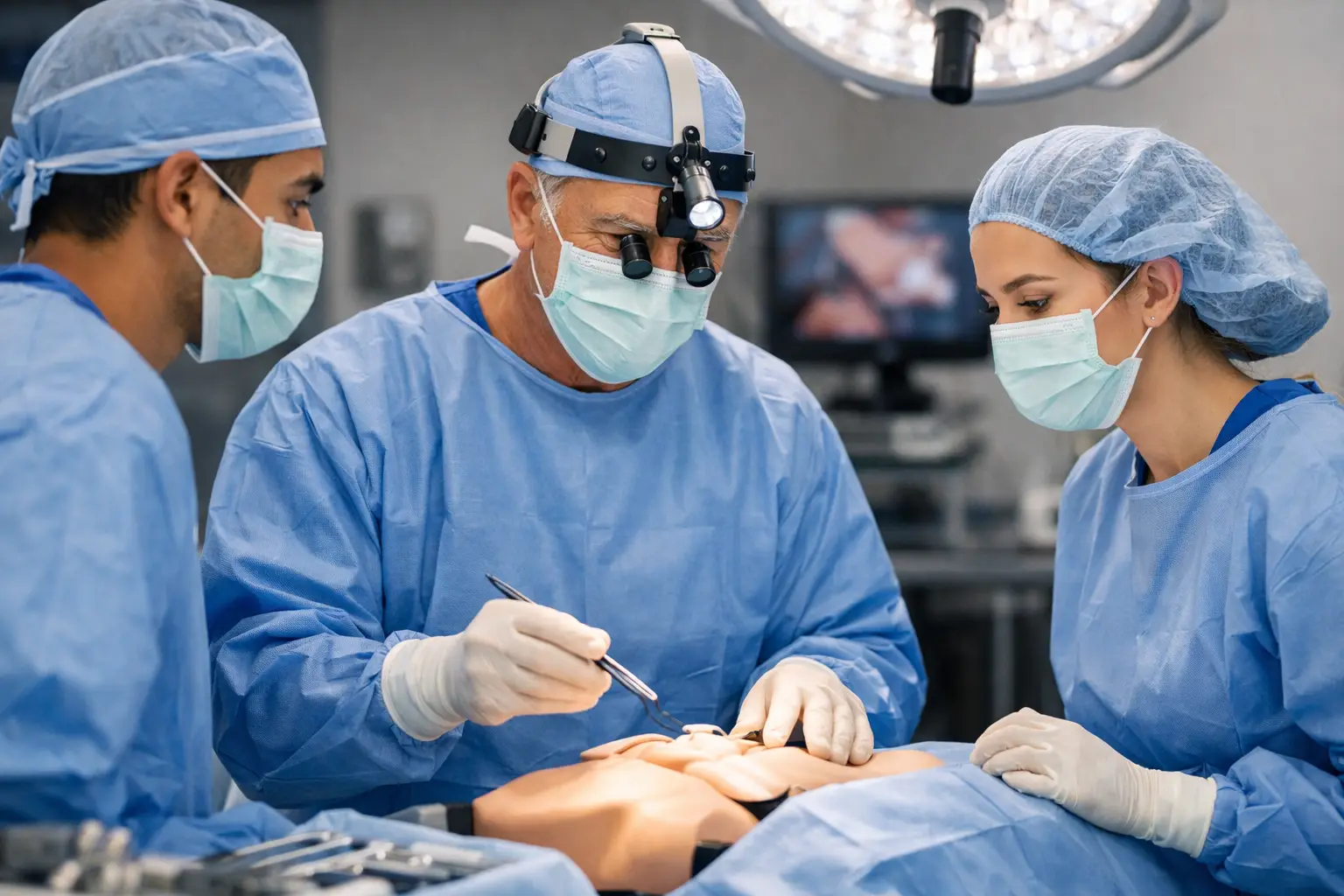
A trainee can watch a flawless operation and still feel unprepared when it is time to make the next clinical decision alone. That gap between observation and safe execution is where surgical education proves its value. At its best, it does not simply transfer information. It develops judgement, technical fluency, anatomical understanding and the confidence to apply all three under real clinical pressure.
For healthcare professionals, this matters at every stage of practice. Undergraduate learners need a clear introduction to operative thinking. Junior doctors and early-career surgeons need structure, repetition and supervised technical progression. Experienced specialists need advanced training that reflects evolving techniques, technologies and multidisciplinary standards. The central question is not whether education is available, but whether it is designed closely enough to real practice to improve patient care.
Why surgical education must go beyond theory
Surgery is a discipline in which knowledge and action are inseparable. A clinician may understand indications, anatomy and peri-operative principles in detail, yet still struggle with instrument handling, spatial orientation or intraoperative decision-making. Equally, technical repetition without a strong theoretical framework can create false confidence. Good surgical education addresses both sides of the problem.
That means theoretical teaching cannot sit in isolation from application. Anatomy should be taught in direct relation to procedural steps. Device education should be linked to indications, limitations and clinical context. Case-based discussion should not end at diagnosis, but move into planning, execution and complication management. This approach produces more than familiarity. It produces understanding that remains useful when conditions are less predictable.
There is also a question of timing. Not every learner needs the same educational depth at the same moment. A medical student observing theatre requires a different level of detail from a registrar refining a specialist technique, and both differ from a senior consultant assessing a new procedural pathway. Effective programmes recognise this and calibrate teaching accordingly.
The foundations of high-quality surgical education
The strongest educational models are structured, progressive and clinically grounded. Structure matters because surgical learning is cumulative. Professionals do not build competence from isolated experiences, however impressive those experiences may appear. They build it from a sequence of learning that moves from principles to demonstration, from demonstration to supervised practice, and from practice to independent judgement.
Clinical grounding matters because abstract teaching rarely changes performance. Learners benefit most when education is closely aligned with the cases, tools and decisions they encounter in hospitals and specialist settings. This is why anatomy-based procedural training, live demonstration, model-based practice and focused technical workshops are so valuable when delivered well. They shorten the distance between learning and use.
Faculty quality is equally important. Experienced clinicians do more than teach technique. They explain why one approach is chosen over another, where errors commonly occur, how complications are anticipated, and what separates adequate execution from excellent execution. That level of teaching is especially valuable for experienced participants, who are not looking for generic instruction but for nuance, refinement and clinically meaningful detail.
Surgical education and the development of judgement
Technical skill is visible, so it often receives most attention. Judgement is less visible, but usually more decisive. The ability to choose the right procedure, adapt a plan, recognise limits and escalate appropriately is central to safe surgical care.
This is one reason mature surgical education includes more than operative mechanics. It should expose participants to planning decisions, patient selection, multidisciplinary discussion and post-procedural reflection. A course that teaches how to perform a technique without addressing when not to perform it is incomplete.
Judgement also develops through comparison. When participants can examine multiple methods, discuss trade-offs and understand why different surgeons may approach the same problem differently, they begin to think at a higher level. There is rarely a single correct answer in clinical practice. There are appropriate decisions based on anatomy, pathology, resources, patient factors and team capability. Education should reflect that reality rather than oversimplify it.
The role of practical learning environments
Hands-on learning remains one of the most valuable components of surgical education, provided it is carefully designed. Practice without context can become mechanical. Context without practice can remain theoretical. The most effective programmes combine both.
Model-based training, 3D planning and anatomy-led workshops can help clinicians translate visual understanding into procedural confidence. These formats allow participants to study relationships, rehearse steps and test strategies before applying them in clinical settings. For complex or less frequently performed procedures, this form of preparation can be particularly useful.
There are practical advantages as well. Controlled training environments allow faculty to pause, explain and correct in ways that routine clinical schedules often do not. Participants can ask more precise questions, compare techniques and repeat difficult elements without the pressures of service delivery. That does not replace supervised clinical exposure, but it strengthens readiness for it.
It is also worth recognising that practical education is not only for surgeons in training. Established clinicians benefit from it when adopting new equipment, revising procedural technique or returning to anatomical fundamentals. Seniority changes the questions participants ask, but it does not eliminate the need for practice-oriented learning.
What modern surgical education should include
Contemporary surgical education needs to reflect the complexity of modern healthcare. That includes technical development, but it also includes communication, team coordination and the safe use of evolving technologies.
For example, equipment testing opportunities can be highly valuable when they are integrated into a broader educational framework. A device demonstration on its own may inform awareness. A structured session that links device characteristics to anatomy, indications and procedural workflow is far more useful. The same principle applies to digital planning tools and procedural simulation. Their educational value depends on how well they are connected to clinical reasoning.
International collaboration also has a meaningful role. Exposure to different training cultures, faculty perspectives and procedural approaches can broaden clinical understanding. For participants working in increasingly connected healthcare systems, this can improve both adaptability and professional judgement. The benefit, however, comes from quality of exchange rather than novelty. International education should add rigour, not spectacle.
This is where institutions such as LNP Academy can offer particular value – by combining structured teaching, practical application and professional course delivery in a format that respects the time and standards of healthcare professionals.
How professionals should evaluate surgical education
Not all programmes described as advanced or hands-on are equally worthwhile. Clinicians choosing a course should look beyond the headline topic and examine how the teaching is built.
The first question is whether the educational aim is clear. A strong programme states what level of learner it is designed for, what participants will actually practise, and what competence or understanding they should leave with. If these outcomes are vague, the educational value is often equally vague.
The second question is whether the faculty have both subject authority and teaching credibility. Technical excellence alone does not guarantee effective instruction. Participants benefit most from educators who can explain processes clearly, respond to varied experience levels and connect specialist knowledge to everyday clinical decisions.
The third question is whether the format matches the objective. If the goal is conceptual understanding, a seminar may be enough. If the goal is procedural development, participants need demonstration, guided practice and meaningful feedback. If the goal is service implementation, broader discussion of logistics, patient pathways and team communication may be necessary. The right format depends on the intended outcome.
Finally, professionals should consider whether the education is likely to transfer into practice. Some programmes are intellectually interesting but difficult to apply. Others are tightly aligned with real procedural needs and therefore far more valuable in the long term.
Surgical education as a career-long discipline
The old idea that education is concentrated in early training no longer reflects clinical reality. Surgical practice changes too quickly, and professional standards are too demanding, for learning to end at qualification or consultancy. New evidence emerges, technologies shift, patient expectations change and multidisciplinary care continues to evolve.
This makes lifelong surgical education a professional necessity rather than an academic ideal. The most capable clinicians are rarely those who believe they have finished learning. They are those who continue refining technique, questioning assumptions and seeking structured opportunities to strengthen practice.
That mindset benefits more than individual careers. It improves team performance, supports service quality and contributes to safer care for patients. When education is treated as an ongoing discipline, not an occasional requirement, clinical standards tend to rise with it.
The most useful question for any healthcare professional is not whether they need more education, but what kind of education will make their next decision, procedure or conversation more precise. Good surgical education should answer that question clearly – and then give professionals the chance to practise the answer.


Leave a Reply